
连连看 · 休闲益智
Shisen-Sho strategy: clearing order and stage mechanic tips
作者: Playship Studios 更新于
由《Play Sichuan》开发商发布的官方玩法指南。
Good Shisen-Sho strategy is less about spotting identical tiles quickly and more about checking whether the pair you remove opens or blocks the next path. Play Sichuan's campaign has four difficulty levels — Easy, Normal, Hard, and Very Hard — with 150 stages each, 600 stages in total.
Every campaign stage is built so that all tiles can be cleared without items or shuffles. If you get stuck, try a different clearing order. New to the connection rules? Read the Sichuan rules guide first.
Board sizes and the 600-stage campaign
Each difficulty is split into 15 chapters of 10 stages. All four difficulties are available from the start, and within a difficulty you unlock the next stage by clearing the previous one. Every campaign stage has a time limit; when time runs out, that attempt's progress and rewards are not recorded.
Boards grow at stages 51 and 101, and later stages add more tile types and shorter time limits. Clearing a stage earns one to three stars, and your remaining time is added as a clear bonus.
- Easy: 7×6 to 8×7 boards, from 150 seconds at stage 1 to 110 seconds at stage 150
- Normal: 9×7 to 10×8 boards, from 145 to 105 seconds
- Hard: 11×8 to 12×9 boards, from 140 to 104 seconds
- Very Hard: 12×8 to 14×10 boards, from 135 to 103 seconds
A clearing order that avoids dead ends
When the same picture appears in several pairs, do not remove just any two tiles. Check that the remaining tiles of that picture can still connect, so you are less likely to trap a final pair.
Clearing tiles along the edges often opens routes from the inner tiles to the empty space around the board. After each match, look again for paths through the newly emptied cells.
If no valid pair remains, the game automatically rearranges the remaining tiles. This reshuffle does not count toward your Shuffle limit, but opening paths early lets you keep playing without waiting for it.
- Start with adjacent pairs or straight connections to create space.
- Clear edge tiles to open routes around the outside of the board.
- When a picture appears in several pairs, remove the pair that leaves the others connectable.
- After each match, check the routes that just opened.
Handling walls, gravity, and stacked tiles
Each difficulty cycles through chapters in the same order three times: basic shapes, walls, gravity, stacked tiles, then a mix. Walls first appear at stage 11, gravity at stage 21, and stacked tiles at stage 31.
Walls cannot be selected, and connection lines cannot pass through them. Around walls, check whether a route can go around within two turns, and clear the open side before the blocked side.
On gravity stages, the remaining tiles shift in the direction shown on screen after every match. Gravity can pull up, down, left, or right, or split outward from the middle horizontally or vertically. Picture the board after the shift before you match, so the pairs you found do not scatter.
A stacked cell holds two or three tiles, and only the top tile is visible and selectable. You need to clear the cell once per tile, and the lower pictures are hidden until revealed, so opening stacked cells early gives you more options.
When to use items and the combo wand
Each game allows up to three Hints, two Shuffles, and three Magic wands. Hint shows one pair that can connect now, Shuffle rearranges the remaining tiles, and Magic wand removes the tile you select together with a matching tile regardless of the path.
A combo continues when you make the next match within three seconds of the previous one. Each time your combo reaches a multiple of 10 — 10, 20, 30 — a wand charges and fires on the next tile you tap. A charged wand does not use your inventory or the per-game limit, so it works well on tiles that are hard to connect, such as those behind walls or in stacks.
Remaining time becomes a clear bonus. When you have time to spare, try finding paths without hints, and save items for the last few pairs when the clock is running low.
Practice larger boards in Free Play
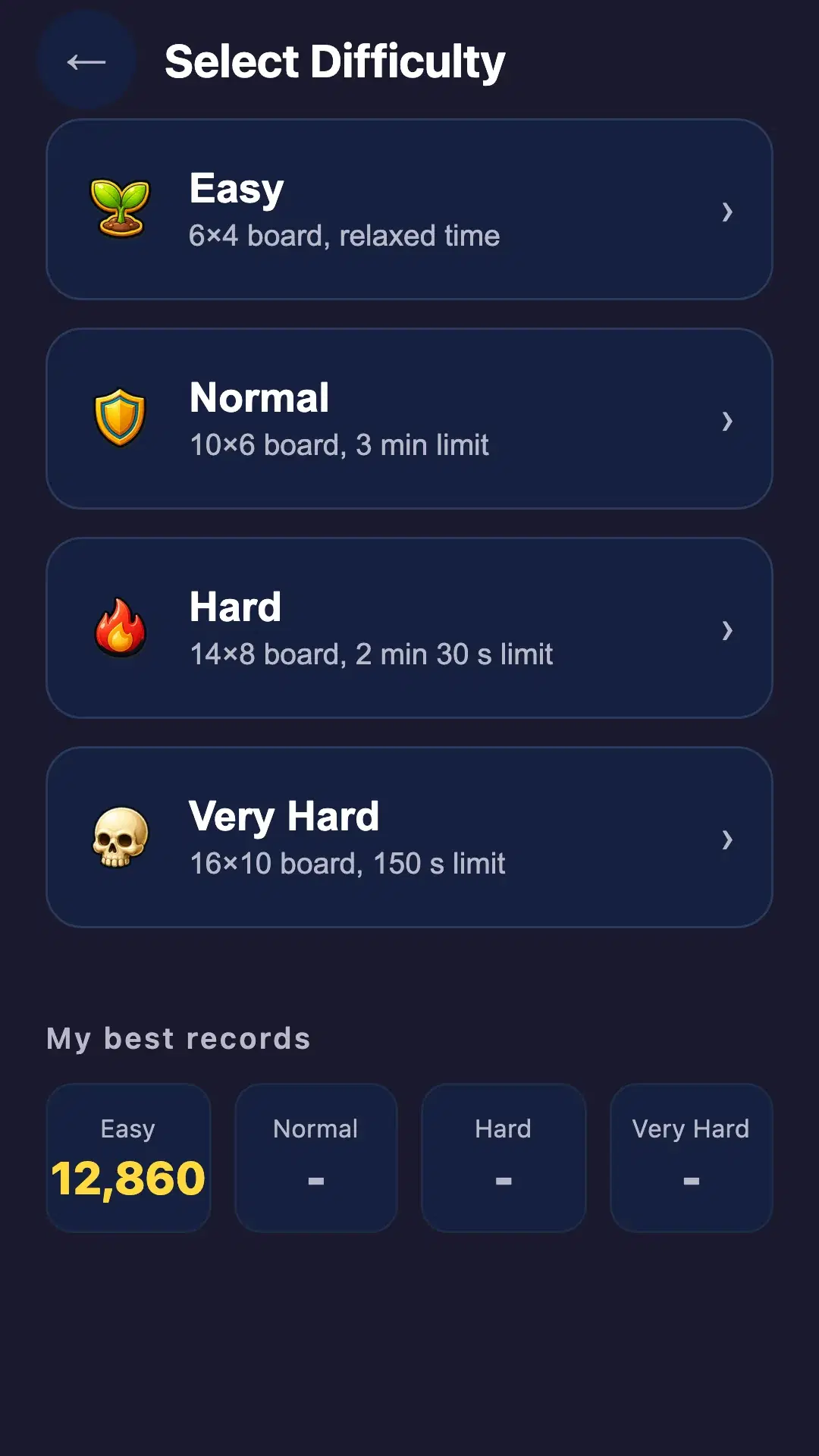
Free Play lets you practice random boards without affecting your progress. Easy uses a 6×4 board with no time limit, Normal a 10×6 board with a 3-minute limit, Hard a 14×8 board with 2 minutes 30 seconds, and Very Hard a 16×10 board with 150 seconds.
If the larger late-campaign boards feel difficult, practice edge clearing and clearing order on the same difficulty in Free Play first.
常见问题
How many stages does Play Sichuan have?
The campaign has four difficulty levels — Easy, Normal, Hard, and Very Hard — with 150 stages each, 600 stages in total. Within a difficulty, clearing a stage unlocks the next one.
Can every stage be cleared without items?
Every campaign stage is built so that all tiles can be cleared without items or shuffles. Stages are timed, though, so Hint and Magic wand can help when you get stuck.
What happens when no valid pair is left?
The game automatically rearranges the remaining tiles. This automatic reshuffle does not count toward your Shuffle limit.
Which way do tiles move on gravity stages?
They move in the direction shown on screen. Gravity can pull up, down, left, or right, or split outward from the middle horizontally or vertically.